


The number of people registered in rural municipalities, those with less than 30,000 inhabitants and whose population density is less than 100 inhabitants per km2, is 7,538,929 people, according to data from the 2020 census, which represents 15.9% of the Spanish population.
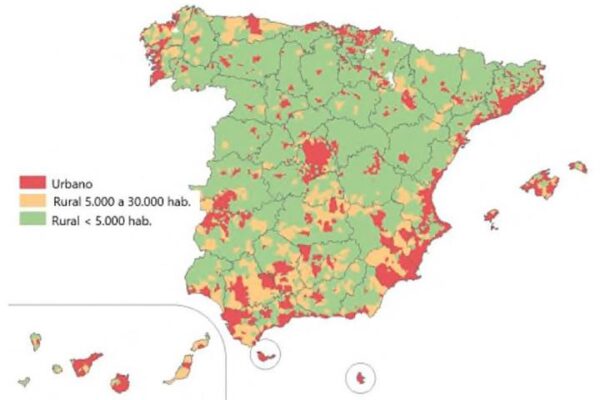

Rural areas cover 84% of the country’s surface. The data is reflected in a document published by the Ministry of Agriculture, Fisheries and Food (MAPA) on its website , which analyses the demographic structure and employment of Spanish rural areas.
The analysis of the demographic processes that characterise rural areas is important for the design and application of regional policies. The changes that have occurred in the Spanish population in recent decades have altered the classic separation between urban and rural areas. The economic diversification of rural populations, and the establishment of increasingly efficient communication networks with cities, have in many cases blurred the existing border between the two. However, there are also less vital territories where the problem of depopulation arises.
The demographic importance of small rural populations is corroborated by observing that 60% of the population living in rural areas is registered in municipalities with fewer than 5,000 inhabitants, half of which would be registered in municipal terms of less than 2,000 inhabitants.
Regarding the evolution in the medium term, the population living in areas classified as rural has decreased by 7.1% in the last 10 years (2011-2020), within a general context of population growth of 0.6%. The decrease has been greater in rural municipalities with more than 5,000 inhabitants. On the contrary, the population registered in urban municipalities has increased by 2.1%. These data are the joint result of demographic processes -natural and migratory-, as well as changes in the typologies of some municipalities, which go from rural to urban or vice versa due to variations in their census or in their population density.
Rural areas have a masculinity index 9.2% higher than in urban areas, with greater masculinisation the smaller the municipality is. This index has decreased by 0.4% in the last 10 years. On the other hand, the youth rate is 35.2% lower in rural municipalities than in urban ones, and it also decreases considerably in those with a smaller population. This rate has decreased by 9.1% between 2011 and 2020.
The autonomous communities with the highest percentage of population registered in rural municipalities, from 30% to 50%, are Extremadura, Castilla-La Mancha, Castilla y León and Aragón.
With regard to employment, the employment rate of the population aged 15 years and over in rural areas is 44.5%, this figure being lower than in urban areas. Rural areas have been somewhat more resilient to the effects of the crisis caused by Covid-19 than urban areas, since employment, although it has decreased, has done so to a lesser degree.