


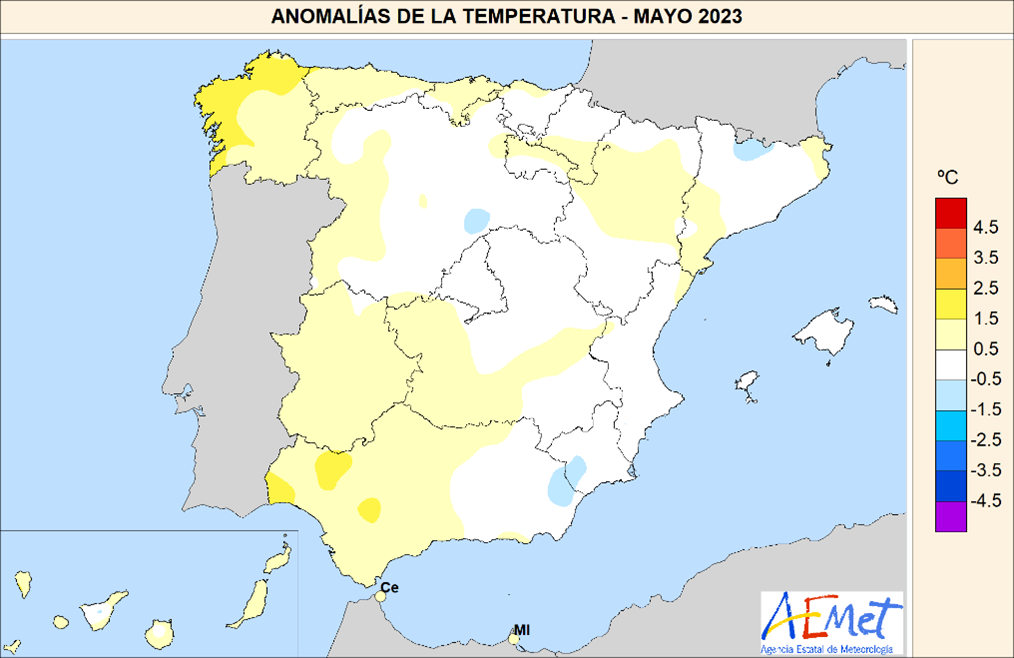
The State Meteorological Agency (AEMET) has published its climate balance for the month of May 2023, in which it shows that it had a “normal” character both in temperatures and in precipitations.
May had a normal character in terms of temperatures, with an average temperature over mainland Spain of 16.0 °C, a value that is 0.4 °C above the average for this month (reference period: 1991-2020). It was the 20th warmest May since records began in 1961, and the 11th warmest in the 21st century.
May began with a warm episode, with both maximum and minimum temperatures well above normal values, which lasted through the first ten days of the month. As of the 11th, a general drop in temperatures was observed, which gave rise to a cold episode between the 12th and 23rd, with highs and lows clearly below the usual ones for the time of year. During the last week of May, the maximums remained below average, while the minimums began to take, in general, values close to normal.
The month of May was normal in terms of rainfall, with an average rainfall value over mainland Spain of 60.0 mm, a value that represents 106% of the normal value for the month (reference period: 1991-2020).
May was between normal and dry in the northern half of the peninsula, reaching very dry in coastal areas of Galicia, inland areas of Castilla y León and central Aragon. In parts of Cantabria, the Basque Country, the northeast of Huesca and a large part of Catalonia, May was wet. On the other hand, May was between humid and very humid in the southern half of the Peninsula, becoming extremely humid in the south of the Valencian Community, Murcia and south of Almería. In Extremadura and the western Andalusian provinces, May was normal, becoming dry in some places. Finally, in the Balearic Islands May has been wet and in the Canary Islands it has been variable.
During the first ten days of the month, the rainfall mainly affected the northern third of the peninsula and to a lesser extent the Levant; in the second ten, they affected almost the entire Peninsula and the Balearic archipelago. Finally, during the last ten, rainfall affected the entire territory, except for the eastern islands of the Canary archipelago. Rainfall in this last section of the month exceeded 30 mm throughout the Peninsula with the exception of areas of the Cantabrian coast and the Ebro valley.
The highest daily rainfall recorded throughout May at main observatories corresponded to Castelló-Almassora with 98.4 mm on the 25th, which is the highest data in its series since 1976; Alicante-Elche/Airport with 56.9 mm on the 22nd; Almería/Aeropuerto with 53.4 mm also recorded on the 22nd, which is the highest value in its series since 1976; Palma de Mallorca/Airport with 52.1 mm, on the 29th; Donostia/San Sebastián/Igueldo with 47.8 on the 11th and Tortosa/Roquetes with 42.8 on the 25th.
Regarding the total precipitation of the month, among the main stations, the 137.5 mm of Alcantarilla stand out, which constitutes the highest value of its series since 1941, Castelló-Almassora with 130 mm accumulated, the 125.7 mm of Alicante -Elche/Airport, which constitutes the highest value of its series since 1967, the 119.5 mm accumulated in Bilbao/Airport, the 116.2 mm accumulated in Donostia/San Sebastián/Igueldo and the 114.3 mm accumulated in Hondarribia/ Malkarroa.


The post With highs and lows May 2023 was overall “normal” in terms of temperatures and rainfall appeared first on Spain Today – Breaking Spanish News, Sport, and Information.