


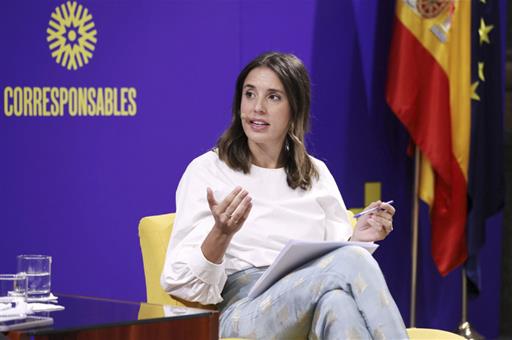
The acting Minister of Equality, Irene Montero, and the Secretary of State for Equality and Against Gender Violence, Ángela Rodríguez, have presented the “MeToca” application, as part of the Co-Responsible Plan, to better distribute domestic and care tasks.
During the presentation, the campaign spot “¿Dónde has estado?” (“Where have you been?”) was also released, with the song of the same name, composed and produced by Sonando Voy and performed by Sofía Vargas.
Both the application and the campaign aim to raise a reflection for Spanish society about the distribution of tasks and, therefore, the distribution and uses of time. “When we think about care, we believe that where we need to focus is on the redistribution of time and tasks,” stated the Minister of Equality in the presentation. “From feminism we have learned that collaborating allows us to move forward. “It’s my turn” aims precisely to do that, that through collaboration we can distribute tasks and end inequality in the use of time. Collaborating everything is much better. It’s time for the usual tasks do not fall back on the same old ones.”
With this new application, which is available for Apple and Android, household and care tasks are counted, and a series of balances are established that assess the distribution of burdens.
Distribution is carried out by family or cohabitation unit and each user who registers is part of a team. In other words, in addition to the traditional role of a couple, other people with whom care is shared, such as sons and daughters or roommates who are usually invisible in this distribution, have been incorporated. In this sense, special attention has been paid to facilitating the use of the application in order to reach a wide audience, without the need for special digital skills.
In relation to tasks, the application has a series of standardised tasks registered and users will also be able to create their own categories. In this regard, special care has been taken to contemplate both physical tasks and those that involve mental workload, normally invisible and assumed mostly by women. This is intended to give visibility to the hidden charges associated with care. Therefore, the application allows adding and modifying the times invested in carrying out the predefined tasks.
In relation to the count, with the recorded data, the application will generate a series of weekly, monthly and annual statistics, which show the time used in carrying out these tasks within the unit or team, and be able to highlight possible existing inequalities.
The majority of women assume a double burden of care, which, in addition to being unfair, makes it impossible for them to develop personally and professionally, or simply to rest. According to the National Survey of Working Conditions carried out by the National Institute of Health and Safety at Work, women invest 12.5 more hours a week than men in unpaid work, to the detriment of their main job, to which they dedicate 5 .8 hours less per week than men.
According to the EPA, 76% of part-time contracts correspond to women, who increase the time dedicated to unpaid work (30 hours a week) when they have part-time work. Men, on the other hand, usually dedicate the same number of hours to unpaid work (14 hours a week), regardless of whether they work part-time or full-time.
The post Government launches new app to enable sharing of household and care tasks responsibly appeared first on Spain Today – Breaking Spanish News, Sport, and Information.