


The acting Minister of Transport, Mobility and Urban Agenda (Mitma), Raquel Sánchez, has highlighted the importance of aligning active mobility policies at the national, regional and local level, so that they are more effective and citizens perceive these changes positively.
The minister highlighted that citizens “ask us for consistency in our decisions; today we cannot create a bike lane and then decide to eliminate it one month later. We should not reduce or remove the Low Emission Zones. It is not acceptable.”
“We must place safety at the heart of active mobility. We cannot afford new risks for the most vulnerable and the generation of rejection of these new forms of mobility. Mobility in urban centres must aim to leave no one behind “, stated, in this sense, the head of Mitma during the inauguration of the third edition of the ‘Urban Mobility Days’, the European urban mobility fair, which is being held in Seville until October 6, organised by the European Union with the support of Mitma, within the framework of the Spanish Presidency of the Council of the EU.
Throughout her speech, the minister has highlighted the relevance of this forum to learn about the trends that define the challenges of mobility in cities and, therefore, it includes all the actors involved: administrations, the business sector, the academic world. For this reason, she insisted that “the conclusions of these days will be very useful to us to improve life in cities and achieve the necessary consensus to avoid taking steps backwards in the fight for more sustainable and green cities.”
The Spanish mobility model promoted by Mitma
As head of the branch, Raquel Sánchez presented in her speech the experiences of Mitma that can contribute to the debate on sustainable mobility, such as “humanising cities.”
Related to this, she has emphasised the need to improve the conditions of local connectivity to facilitate access to opportunities and always place safety at the core of active mobility, with the integration of public transport in pedestrian spaces and transportation infrastructures, and micro mobility. All of this, with an institutional effort to improve communication and training to help change attitudes and behaviours regarding new forms of mobility, so that citizens feel involved in it.
“In our case, public transportation has been one of our assets to protect citizens from the consequences of the Russian invasion of Ukraine and, at the same time, combat inflation and reduce our energy dependence and consumption of fossil fuels. Today “I can say that we were right with measures such as free suburban and mid-distance rail services and discounts on bus and suburban services. They have worked and have enjoyed enormous acceptance by citizens,” she indicated.
She has also pointed out the concern in the sector about the lack of professionals and, especially, in road transport segments. For this reason, she highlighted that during these days there will be a debate on how to redirect this situation and how to attract young people to work in an increasingly technical and innovative sector to “incorporate the new human capital that comes out of our educational systems to the transportation sector”.
Safe, Sustainable and Connected Mobility
The acting minister has stated that the Ministry’s policy has focused on promoting mobility policies, with the development of the Safe, Sustainable and Connected Mobility Strategy, which is fully in line with that published by the European Commission.
To carry out this strategy, she added, the Recovery Plan and the NextGenerationEU European funds have been fundamental, with which multiple initiatives by local and regional entities are being financed aimed at promoting public transport, decarbonization and a new form of mobility or micromobility, increasingly present in our cities.
Furthermore, from the Ministry, and thanks to the Recovery Plan, nearly 6.5 billion euro are allocated to deploy low-emission zones, to renew public transport to reduce its emissions, to promote active mobility and promote a modal shift towards railway in urban and metropolitan transport.
In this sense, she has also emphasised the importance of having a flexible roadmap such as the Spanish Urban Agenda, among whose objectives is to humanise our cities and towns, avoid urban dispersion, revitalise the existing city, increase the proximity and promote sustainable means of transportation.
The example of Seville
Raquel Sánchez has put the city of Seville, headquarters of the ‘Urban Mobility Days’, as an example of all this, when a little over a year ago the City Council approved its Urban Agenda Action Plan.
“We are allocating more than one hundred million euro from the Recovery Plan here to make projects such as bike lanes, the purchase of trams or 100% electric articulated buses a reality,” the minister stated by way of balance.
At this point, she recalled the importance of collaboration between administrations to advance the objectives of sustainable mobility, giving as an example the promotion of the extension of line 3 of the Seville metro and the execution of the study of the railway connection between the Station from Santa Justa and the airport.
“In short, large investments and numerous actions that have been the result of collaboration with the previous municipal corporation and that, I hope and trust, will continue because they are the result of the common interest, between institutions, to make Seville a more sustainable city, more accessible and better,” stated the head of Mitma.
European Bicycle Declaration
Finally, the minister has expressed her satisfaction at being in Seville where the Commission has presented the European Cycling Declaration, which points out the bicycle as a key means of the new active mobility, increasingly present in our cities.
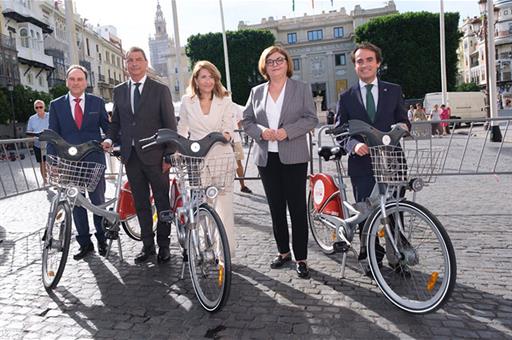
And this morning the minister accompanied the European Commissioner for Transport, Adina Vălean, during the presentation of the European Bicycle Strategy, an event in which she highlighted that Europe “needs a coordinated policy on this issue, which is a driving force of the different very local initiatives to give them a more global dimension”.
“This Initiative has the support of the Spanish Presidency and we hope that it will be approved with the next presidency, the Belgian one, of the Transport Council,” said the minister.
“As policy makers we have to address the growing demand and facilitate, especially in urban environments, the use of bicycles. There are many instruments: infrastructure for the circulation of bicycles such as bike lanes; reserved parking; public rentals; information on circuits…”, highlighted Raquel Sánchez before putting the State Bicycle Strategy as an example of Mitma’s commitment to this mobility model that Spain has “joined in record time.”
The post The importance of aligning active mobility policies at the national, regional and local level appeared first on Spain Today – Breaking Spanish News, Sport, and Information.