


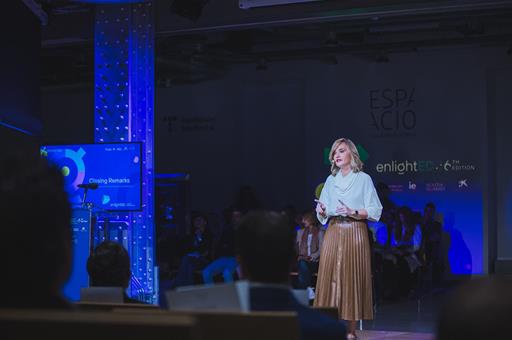
The acting Minister of Education and Vocational Training, Pilar Alegría, has closed the global meeting on education, innovation and technology EnlightED 2023, dedicated this year to rethinking education in the era of artificial intelligence (AI).
In her speech, the acting minister highlighted the importance of developing this technology in an “ethical and responsible” way, and that it serves to improve the educational system. In this process, teacher training in digitalization is key, she added.
“The arrival of artificial intelligence is unstoppable and we have to make it a tool to make education better for everyone. That is why, in Europe, we are committed to ethical and responsible artificial intelligence as a safer means to achieve this great objective,” said Alegría, who recalled that the European Union is working on the definitive approval of the first law on AI in the world.
In the educational field, the new regulation will require that its use be considered a high-risk activity, so that “all possible guarantees are adopted,” Alegría stressed.
“We have to have a balanced view regarding the problems and benefits that artificial intelligence brings us to the classrooms,” highlighted the acting minister. It has thus addressed the need to respond to the dangers associated with these new technologies, but also its advantages in the educational field, such as greater personalisation of education, the generation of specific content for each learning situation, the reduction of the burden of bureaucratic information for teachers or tools for language practice, among others.
“Once again the evidence emerges that the fundamental role corresponds to teachers,” who “need training, need experiences and pilot projects to check how things work and need to adapt technology to their specific pedagogical project,” she said. “That is why the effort in teacher training is one of the most important lines of work within the digitalization programs that we are financing with the European Next Generation recovery funds.”
In this sense, Alegría recalled the recent update of the Reference Framework for Digital Teaching Competence and the launch in 2018 of the School of Computational Thinking and Artificial Intelligence of the National Institute of Educational Technologies (Intef), which offers open educational resources and training to help Spanish teachers incorporate this skill into their teaching practice through programming and robotics activities.
Students are also being trained in digital skills, including programming and robotics, to make “safe, healthy, sustainable, critical and responsible use of digital technologies.”
“José Antonio Marina says that in our classrooms there is already the ‘Centauro Generation’, which is going to have to integrate the two types of intelligence, natural and artificial. A task that only well-trained teachers can and should do,” Alegría concluded.
The post “We are committed to ethical and responsible artificial intelligence” appeared first on Spain Today – Breaking Spanish News, Sport, and Information.