





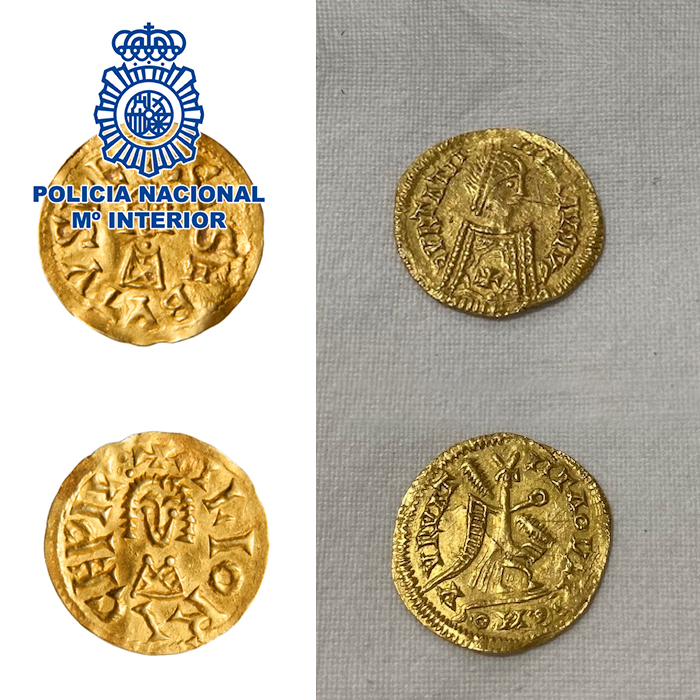
Agents of the National Police have recovered in León and in the city of Saceruela two Visigoth coins considered of great historical value. It is about two tremisses, and one of them presents an onomastic variant unknown until now that makes it unique and increases its value.
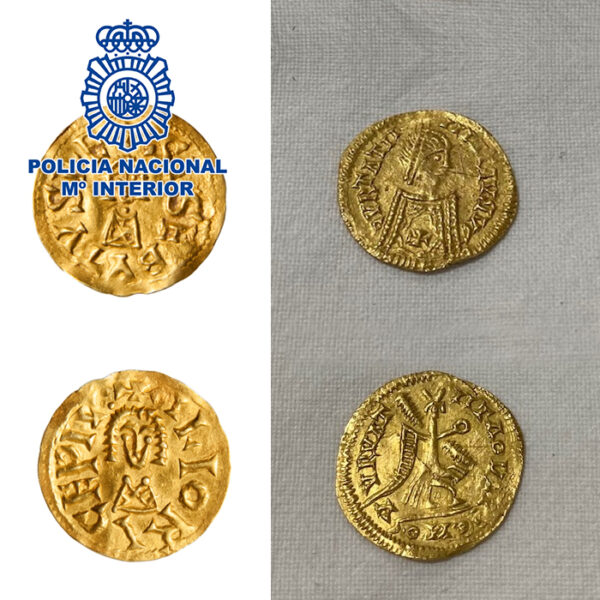
The action that allowed the recovery of the first tremís is part of the information gathering work that the National Police systematically carries out to detect and recover pieces of interest to the historical heritage. In this way, it was learned that a person had found a gold coin while carrying out reconditioning works in a home in León. After contacting that person, he was summoned to the police station, proceeding to the recovery of the coin. The consultation with specialists in numismatics has revealed that the recovered coin would be a tremís of Sisebuto, Visigoth king who reigned between the years 612 and 621.
This type of mintage occurs frequently in Carthaginensis and, occasionally, in Gallaecia. The toponym that can be seen on the coin is that of the “Iliocrici” mint, a place that would correspond to the current Lorca, in the province of Murcia. To date, only two specimens of Visigothic currency with this provenance were known, one from Sisebuto and the other from Sisenando. The recovered coin is, therefore, the third, and has the exception that it is an onomastic variant unknown until now, which significantly increases its value. After its recovery, it has been delivered to the Provincial Museum of León.
A tremís found thanks to tracking on social networks
The second coin found by the National Police was recovered in Saceruela, Ciudad Real province, from the tracking that the agents carried out on social networks, where the publication of an old coin was detected whose advertiser showed interest in its value.
The investigations made it possible to identify the user of the profile that advertised the coin. It was a tremís from the Visigothic period, manufactured with the aim of imitating others from the Roman or Byzantine period so that, in this way, it was accepted in the commerce of the time. This coin could imitate another from Anastasius I (491-518) and correspond to the Visigoth reigns of Alaric II, Gesaleico or Amalarico.
With this information, the National Police agents travelled to the town of Saceruela to contact the person who possessed the coin, where they proceeded to recover it.