






The Minister of Health, Carolina Darias, has underlined the good development of the State Vaccination Strategy against SARS-CoV-2, with more than 81.6 million administered doses, almost 90% of the population over 12 years old with complete regimen, about 10 million booster doses inoculated and the Paediatric Vaccination Campaign underway.
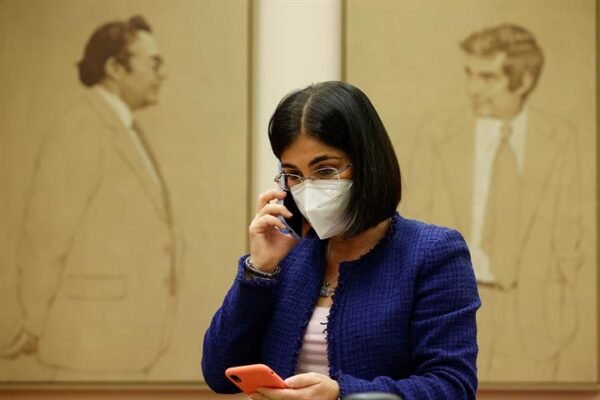
Carolina Darias has reaffirmed the determination of the Government of Spain to continue facing the pandemic caused by COVID-19 and the new health challenges hand in hand with scientific evidence, “with vaccination, with prevention and in advance”.
This has been underlined during her appearance before the Health and Consumption Commission of the Congress of Deputies, where she has reported, at her own request, on the current status of the evolution of the pandemic caused by COVID-19, the State Vaccination Strategy and the actions of Spain in the international donation program of vaccines against SARS-CoV-2.
As Darias explained, “if there is something that has become clear to us, it is that vaccines work” and that the scientific evidence itself “urges us to vaccinate, vaccinate and vaccinate”, as the main way to overcome the pandemic; scientific evidence, he continued, which has also highlighted that “vaccination must be accompanied by prevention.”
The Minister of Health has underlined the importance of insisting on non-pharmacological measures of the culture of care in the run-up to the Christmas holidays, with the aim of being able to enjoy them “as safely as possible.”
In this sense, she reiterated the importance of maintaining social distance and avoiding crowds, hand hygiene and the use of masks, both in closed spaces and in open spaces where the safety distance cannot be maintained.
Along the same lines, she has applauded the good example of individual and collective responsibility that the country represents since the beginning of the pandemic and in the face of any of the different variants that have emerged over the months.
Carolina Darias has also reaffirmed the commitment of the Government of Spain with the improvement and reinforcement of the capacities of the National Health System, recognising its role as a fundamental pillar of the Welfare State, thanks to the health professionals who “are the cornerstone of a public health of which we are proud”.
On the other hand, she underlined the good development of the State Vaccination Strategy against SARS-CoV-2, which has placed Spain as a leader in its different milestones over time and until the very launch of the Paediatric Vaccination Campaign that began its journey this Wednesday.
“We were the first country in the European Union to immunise 100% of those over 80 years of age and, today, we are in the leading positions in the world for vaccination coverage, with almost 90% of our population over 12 years of age with complete guideline”, highlighted Darias.
At this point it has meant the role developed by all the administrations concerned through the co-governance bodies of the Interterritorial Council of the National Health System; a performance that has earned the State Vaccination Strategy the recognition of both the president of the European Commission, Ursula Von der Leyen, and the director of the WHO in Europe, Hans Kluge, who has agreed with the Government of Spain to document the good practices to serve as an example to the rest of Europe and the world.
On the other hand, Carolina Darias has reiterated the support of the Government of Spain towards the solidarity donation of vaccines against COVID-19. “No one will be safe until everyone is,” recalled the minister, who has simultaneously called for “unity of action and co-governance” to fight against “a global pandemic that requires a multilateral response.”
Spain, Darias highlighted, is a leading country in national vaccination -with more than 81.6 million doses administered- and the fifth in the world in effective delivery of solidarity vaccines -with more than 40 million doses donated-; a work that has been recognised by the director of the WHO, Tedros Adhanom, who has set Spain as an example to be followed by the rest of the countries.
In this context, it has framed the pioneering transfer of the patent for a Spanish diagnostic test, the result of the agreement between the CSIC and the C-TAP; an action that will benefit many countries thanks to the UN initiative ‘Medicine Patent Pool’ and for which the WHO has also publicly congratulated Spain.
“This is action, commitment and solidarity. This is putting Spain at the forefront of global equity,” said Darias.
Along these lines, she reiterated that Europe can and must contribute to the WHO goal of vaccinating 70 percent of the global population by mid-2022.
It is “a matter of political will” that, in the case of Spain, will crystallise with the donation of the 50 million doses promised by President Sánchez to COVAX before the end of the first quarter of 2022.
Present and future projects in health matters
On the other hand, the Minister of Health has called for the unity of action of all parliamentary groups to participate with commitment and political determination in the successes of Spanish public health.
In this sense, she has referred to the progress made in public health since Pedro Sánchez became president of the Government, beginning with the recovery of the universality of public health, “so as not to leave anyone behind.”
Among the outstanding projects, Darias has cited the approval of the Euthanasia Law, the first Strategic Health and Environment Plan, the first update of the Mental Health Strategy in more than a decade or the forthcoming approval of a Health Action Plan Mental and COVID-19, “with a historical investment of 100 million euro” and the launch of a 3-digit telephone number, for attention to suicidal behaviour.
The Minister of Health has also underlined the Investment Plan in High Health Technology (INVEAT), through Next Generation funds, with which some 850 equipment in the public technology park and the forthcoming incorporation of proton therapy will be renewed and expanded to the National Health System, through the agreement signed with the Amancio Ortega Foundation.
It has also highlighted the processing of the Draft Law by which certain laws are modified to guarantee equity, cohesion and universality of the SNS; the Ministerial Order that restored the right of all women to assisted reproduction and that, for the first time, incorporates trans people with a pregnant capacity; the incorporation of new drugs to the common portfolio of services, such as Kaftrio; or the provision of 18 million euro to healthy cities projects, through the FEMP.
Likewise, it has underlined the expansion of the offer of Specialised Health Training places, the launch of a continuous training plan endowed with 10 million euro and the recently approved Primary Care Action Plan, to promote it as a backbone of the National Health System.
Lower incidence of the virus in vaccinated people
As explained by the Minister of Health, the Accumulated Incidence at 14 days per 100,000 inhabitants stands at 441 cases nationwide, according to the latest data available, having a higher incidence in age groups with less vaccination coverage.
In fact, as Darias has meant, a higher incidence is observed in those under 12 years of age, while the AI curve has stabilised between the age groups of 60 to 69 years and of 70 years and older. “It is most likely influenced by the high vaccination rates, including the booster dose, as well as a higher level of compliance with personal protection measures,” she highlighted.
The minister has highlighted the positive impact of vaccines, with percentages of hospitalisation and ICU up to three times lower and deaths almost ten times lower than in the second, third and fourth waves, when vaccines were either not available Or, the current degree of coverage had not been reached.
As detailed, the incidence in fully vaccinated people is much lower than that observed in non-vaccinated people. Thus, between October 11 and December 5, 2021, in the 60 to 80 age group, a risk of infection, hospitalisation and death is observed up to 14 times lower than in unvaccinated patients and admission to the ICU up to 22 times lower . Along these lines, in the group aged 30 to 59 years, the total incidence is 2 times lower and more than 7 times lower for hospitalisation.
“The incidence in all vaccinated people is consistently below half of that observed in non-vaccinated people,” stressed the Minister of Health.
As for the SARS-CoV-2 variants, it has been reported that the dominant one in Spain continues to be the Delta, although the new Omicron variant has registered a total of 40 cases by sequencing, of which about half have not been possible to link to travel or contact with international travellers for now. In any case, Omicron variants have already been identified in random sample of cases, which implies that, although with a very low prevalence, below 1%, this variant would already be circulating in our country.
Vaccination strategy and Foreign Health
The Minister of Health has also detailed the data recorded to date in the context of the development of the Vaccination Strategy, thanks to which “we have vaccinated an entire country against COVID.”
Thus, 81.6 doses of the 4 available sera have been administered, almost 90% of the population older than 12 years and 94.7% of people older than 40 years have received the complete vaccination schedule, in addition to having administered nearly 10 million booster doses to the indicated population groups.
However, in the current epidemiological context, Darias has insisted on the need to continue insisting on the vaccination of people over 12 years of age who have not yet completed the primary vaccination and, especially, the administration of booster doses in the population of more 60 years of age, as well as health and social health professionals.
Finally, she reported on the start of the Childhood Vaccination Campaign on December 15, underlining and thanking “the commitment and responsibility” of children and their fathers and mothers, “to continue contributing to the protection of our population “.
As Darias explained, vaccination in the child population will contribute to reduce the burden of disease in this group, as well as transmission in the family environment, in educational centres and in the community, contributing to the protection of the most vulnerable populations.
On the other hand, the minister has informed the Health and Consumer Commission that, between January 1 and November 30, 2021, more than 26.5 million passengers from 253 countries and about 230,000 flights from 102 countries, through the Foreign Health services.
Passengers were controlled upon arrival through the Spain Travel Health (SpTH) information system and of the total, 181,185 activated the red code in the primary control, and 181,185 travellers passed a medical evaluation in the secondary control.
All this activity, Darias highlighted, has required the multiplication of the available resources by more than 10, to carry out health controls at airports, with more than 2,000 people provided by AENA to support Foreign Health activities, thanks to an agreement signed with the General Directorate of Public Health and AENA.
At this point, the minister has also valued the speed and effectiveness with which it has responded to the different measures approved on the occasion of the Omicron variant, in the control of travellers from the high-risk countries concerned.
Thus, from November 29 to December 14, 794 people from the countries described above were sent to quarantine, which represents approximately 0.07% of the total number of passengers. In the controls carried out on arrival at the airport, both documentary and antigen test, 8 passengers with a positive antigen test from South Africa, with confirmed Omicron variant, have been detected. And throughout the follow-up carried out, as in the previous quarantine, by the Ministry of Defence, 6 positives have been identified, still pending confirmation of the type of variant.