





The State Meteorological Agency (AEMET), under the Ministry for the Ecological Transition and the Demographic Challenge, has released its climate balance for the month of April 2023, revealing that the month was the warmest April since 1961, when records began, having exceeded April 2011 by 0.1°C, so far the warmest in the series.
The month of April has been extremely warm as a whole, average temperatures have been around 14.9 °C, a value that is 3.0 °C above the average for this month (reference period: 1991-2020).
The maximum daily temperatures in April were on average 4.7°C above the normal value. For their part, the minimums were 1.3°C above the average, resulting in a daily thermal oscillation 3.4°C higher than the normal for the month. In thirty main stations, the average temperature for the month was the highest for an April since records exist. In forty-five main stations the mean maximum temperatures were the highest in the April series, and in four the mean minimum temperatures were also the highest in April since the beginning of the observations.
Thermal anomalies close to +4 °C were observed in inland areas of Andalusia, eastern Extremadura and southwest of Castilla-La Mancha, reaching values close to +5 °C in some points of these regions. In the rest of the southern half of the peninsula, as well as in areas of the Cantabrian mountain range, the Ebro valley and southern Castilla y León, the anomalies were around +3°C. In the rest of the peninsula, the anomalies were close to +2°C, except in areas of the eastern Cantabrian Sea and the coasts of Catalonia and the Valencian Community, where they reached values close to +1°C. In the Balearic Islands, the anomalies took values between 0 °C and +2 °C, while in the Canary Islands they were between +1 °C and +3 °C.
Among the main observatories, the 38.8 °C of Córdoba/airport, the 37.4 °C of Morón de la Frontera, and the 36.9 °C of Granada/airport and Seville/airport stand out, all values measured on the 27th of April.
Regarding the minimums, the lowest values were observed in the first days of the month, standing out among the main stations the -8.1 °C of Molina de Aragón registered on the 5th, the -6.9 °C of Burgos/airport on the 5th, the -5.2 °C of Valladolid/airport also on the 5th, and the -4.6 °C of Puerto de Navacerrada registered on the 13th. In the main station of Burgos/airport the minimum of day 5 it was the lowest for an April since the beginning of the series.
AN EXTREMELY DRY MONTH
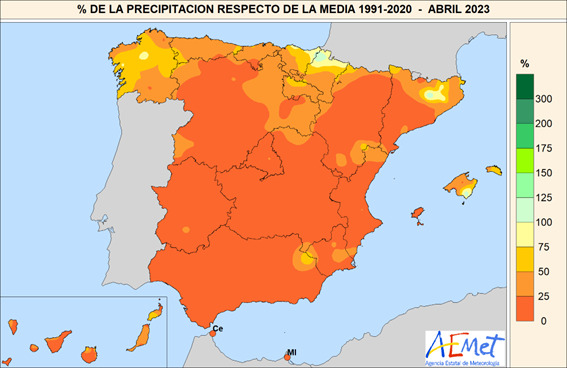
The month of April was extremely dry in terms of rainfall, with an average rainfall value over mainland Spain of 14.2 mm, a value that represents 22% of the normal value for the month (reference period: 1991-2020). It has also been the driest April since records began in 1961.
April has been between extremely dry and very dry in almost the entire Peninsula, the island of Ibiza and the western Canary Islands. April has been between dry and normal in Galicia, northern Catalonia, parts of Castilla y León, northern Navarra, north-eastern Basque Country, coastal areas of Murcia and the eastern Canary Islands, where it has been normal.
During the first 10 days of the month, rainfall was scarce and affected the northern third of the peninsula, the Balearic archipelago and, to a lesser extent, the Canary Islands. 40 mm were exceeded at points on the Cantabrian coast and the western Pyrenees, as well as on the island of Majorca.
In the second 10 days, rainfall affected the northern half of the Peninsula, the north of the western Canary Islands and, to a lesser extent, the Balearic archipelago. 10 mm were exceeded in Galicia, along the Cantabrian coast and in the north of the island of Tenerife. In the western half of the Pyrenees and in areas of A Coruña and Pontevedra, rainfall reached 40 mm.
In the third and final 10-day period of the month, the rainfall affected a large part of the Peninsula with the exception of points in Andalusia, southeast of Castilla-La Mancha and the interior of the Valencian Community. No rainfall was recorded in the archipelagos except on the island of La Palma in the Canary Islands and northwest of the island of Majorca in the Balearic Islands. 10 mm were exceeded in the northern third of the peninsula, at points in the Central system, in the western half of Salamanca, north of the province of Cáceres and north of Castellón. In the western half of Galicia and in areas of the Pyrenees, more than 60 mm accumulated, with some specific areas with more than 100 mm.
The highest daily rainfall recorded in main observatories corresponded to Santiago de Compostela/airport with 57.8 mm on the 22nd; Hondarribia/Malkarroa with 35.2 mm on the 12th; Vigo/Aeropuerto with 31.8 mm registered and Pontevedra with 26.2 mm, on the 13th. Regarding the total precipitation of the month, among the main stations, the 116.3 mm of Hondarribia/Malkarroa, Santiago de Compostela/ airport with 103.4 mm accumulated and 101.6 mm from Vigo/Airport.
The post April 2023 was the warmest and driest April on record in Spain appeared first on Spain Today – Breaking Spanish News, Sport, and Information.
Other Articles