




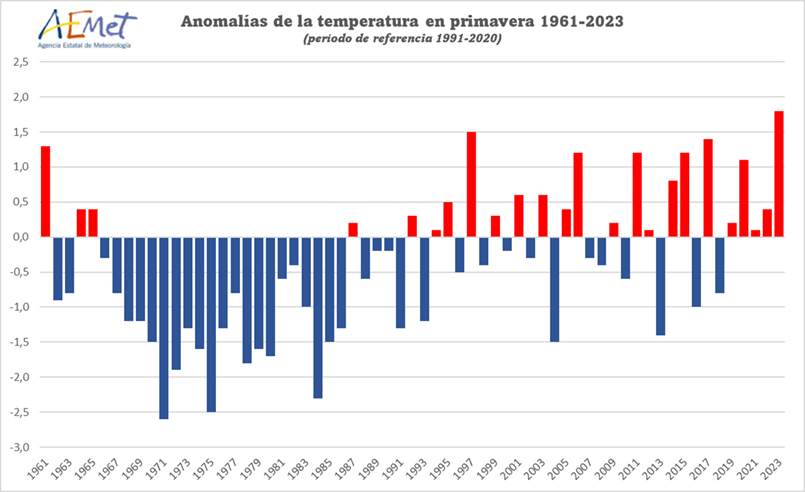
The State Meteorological Agency (AEMET), under the Ministry for the Ecological Transition and the Demographic Challenge (MITECO), has published its balance sheet for the spring of 2023, which was the warmest in the historical series, since 1961.
It was an extremely warm spring, with a temperature in mainland Spain of 14.2 ºC, which is 1.8 ºC higher than the average for the reference period 1991-2020 and 0.3 ºC higher than the warmest to date, which was the year 1997.
The months of March and April were very warm: March was the third warmest in the series, while April was the warmest, with an average temperature 3ºC higher than the normal average and with a significant episode of high temperatures at the end of month: between the 25th and 29th, all the days were the warmest for those dates since at least 1950.
Córdoba reached a maximum temperature of 38.8 ºC, the highest recorded in mainland Spain in April. May, on the other hand, was a normal month as a whole, although with marked differences between the first ten days, which made up a warm period, and the rest of the month, with temperatures generally below normal in Spain as a whole.
In terms of rainfall, spring was very dry. It was, in fact, the second driest spring in the historical series with an accumulated precipitation in mainland Spain of 95 l/m², a figure that corresponds only to 53% of the normal value for the reference period 1991-2020. Only the spring of 1995, with 85 l/m², was drier than that of 2023, and these are the only cases, since at least 1961, in which at least 100 l/m² did not accumulate in spring.
March was a very dry month, since rainfall only reached 36% of its normal value; it was the sixth driest in the series. April was extremely dry, with rainfall barely exceeding a fifth of normal; it was the driest since records began. Finally, May was left with a normal character in terms of rainfall, thanks to the continuous showers that occurred, almost universally, in the peninsular territory and the Balearic Islands, during the second half of the month.
Given the very dry nature of the spring of 2023, at the end of the season Spain was still in the situation of meteorological drought that began in the winter of 2021-2022. The long-term drought (corresponding to the analysis of the rainfall of the previous thirty-six months) that began at the end of last year also persisted.
According to seasonal prediction models, there is between a 50 and 60% chance that the meteorological summer, made up of the months of June, July and August, will be warmer than normal on the Peninsula. The probability rises to 70% in the archipelagos. There is only a 10-20% chance that the summer will be colder than normal. Regarding rainfall, except for the Bay of Biscay and the Canary Islands, where there is no clear trend, there is a probability of between 40 and 50% that rainfall remains above normal in the quarter, compared to 20-25 % that fall below.
The post Spring 2023 was the warmest and second driest in the history of Spain appeared first on Spain Today – Breaking Spanish News, Sport, and Information.